Each month I write an article for ICAEW on the monthly public sector finance release. Here are my most recent articles:
Public sector net debt hits £3tn ahead of budget
Rising inflation and budget overruns provide a difficult backdrop for John Healey as he prepares for his first fiscal event. The Chancellor is under pressure to provide more support for rising energy bills, but the challenges to balance spending are mounting.
Budget overrun widens as public finances disappoint
The triple whammy of geopolitical uncertainty, persistent inflation and rising gilt yields are squeezing the public purse as the Chancellor prepares for his first budget.
Read More
www.icaew.com
UK net debt in touching distance of £3.0tn
Latest data confirms that the UK’s public finances remain weak, despite taxpayers facing the highest tax burden since the 1960s. The Chancellor faces significant challenges if he is to increase public spending, says ICAEW.
Our chart this week looks at how the five-year fiscal forecasts have consistently proved too optimistic in recent years, something to bear in mind as the budget approaches.
Read More
www.icaew.com
Chart of the week: disposable income
Our chart this week looks at how income is distributed across UK households with a median equivalised household disposable income of £3,265 per month and an equivalised average of £3,800 per month.
Read More
www.icaew.com
Chart of the week: UK productivity remeasured
Our chart this week looks at how the ONS is changing how it calculates labour productivity – one of the most important factors driving economic growth.
Read More
www.icaew.com
Chart of the week: public sector workforce
Our chart this week looks at how one third of the 6.2m public sector workforce work for the NHS while 9% work for the Civil Service.
Read More
www.icaew.com
Chart of the week: OBR long-term fiscal forecast
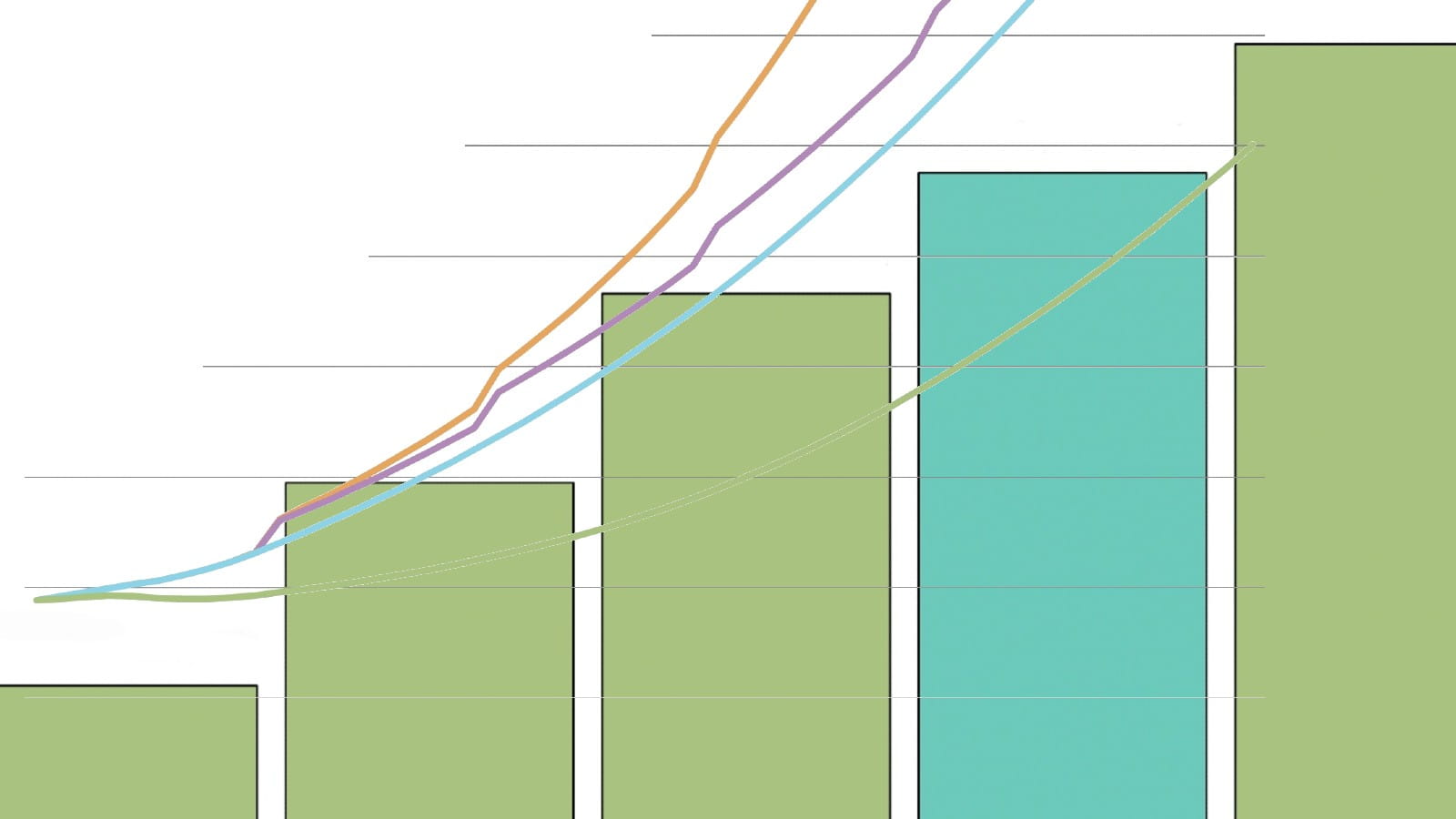
Our chart this week shows how alternative scenarios go off the chart in the OBR’s latest long-term fiscal projections.
Read More
www.icaew.com
Chart of the week: long-term interest rates
Our chart this week highlights how long-term borrowing costs have changed over the past year in Japan, Germany, France, the US and the UK.
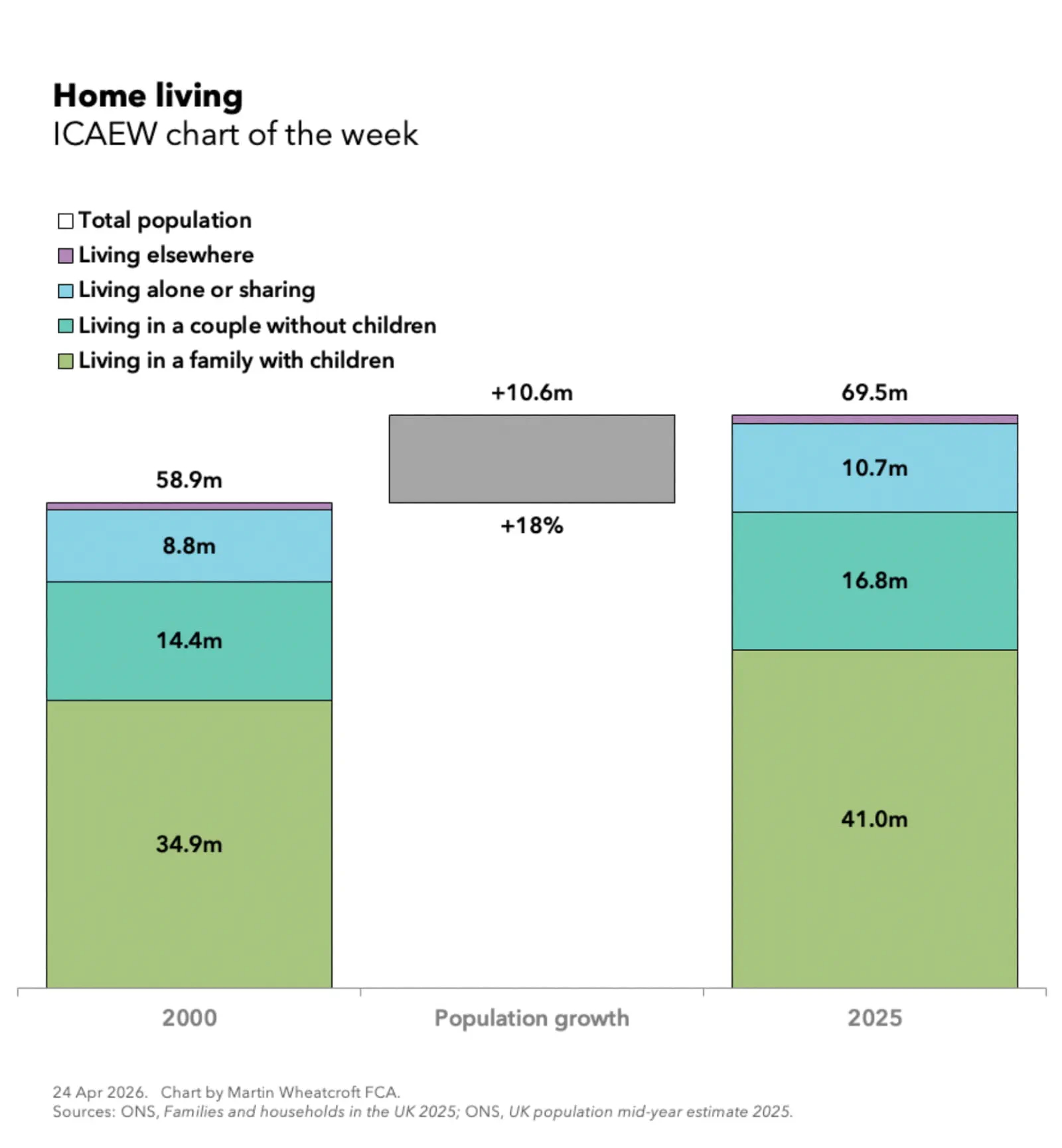
My chart for ICAEW this week is on how people in the UK still live in broadly the same type of households as they did 25 years ago, despite the population growing by 18% over that time.
My chart of the week for ICAEW is on the composition of households in the UK in 2025 and how they compare with the start of the century.
According to the Office for National Statistics (ONS), the total population of the UK in 2000 was 58.9m people, increasing by 10.6m or 18% to 69.5m people in 2025. The ONS also analyses the different types of family groupings for the 58.1m people living in households in 2000 and 68.5m in 2025.
As the chart illustrates, the 34.9m people living as part of a family with children or in multi-family households in 2000 rose by just over 17% to 41.0m in 2025, while the 14.4m people living as part of couples with no children in 2000 increased by just under 17% to 16.8m in 2025. The 8.8m people living alone or sharing with unrelated adults in 2000 increased by 22% to 10.7m while the number of people living elsewhere (generally in community establishments) rose by 0.8m people in 2000 to 1.0m in 2025.
The 34.9m and 41.0m people living as part of a family with children or in multi-family houses in 2000 and 2025 respectively can be analysed between 17.0m and 20.2m living in households headed by a couple with one or two dependent children, 5.5m and 5.0m headed by couples with three or more dependent children, 5.2m and 6.3m headed by couples with non-dependent children only, 6.3m and 8.2m in families headed by lone parents, and 0.9m and 1.3m in multi-family households.
The 8.8m and 10.7m people living alone or sharing in 2000 and 2025 comprise 7.0m and 8.6m living alone and 1.8m and 2.1m sharing with unrelated adults.
The ONS does not give an analysis of the 0.8m and 1.0m living elsewhere in 2000 and 2025, but data from the 2021 census for England and Wales suggests that approaching half live in educational accommodation (student halls and boarding schools) and around a third live in care homes, with the balance in prisons, on military bases, in temporary accommodation, in hospitals, and within religious establishments among other types of accommodation.
Analysing the changes
As a proportion of the total, there has been a 0.4 percentage point decline in the proportion of people living as part of a family with children from 59.4% to 59.0% over the last 25 years and a 0.3 percentage point decrease in the proportion living in couples without children from 24.4% to 24.1%. Meanwhile, the proportion living alone or sharing increased by 0.5 percentage points from 14.9% to 15.4% and the proportion living elsewhere increased by 0.2 percentage points from 1.3% to 1.5%.
Within these categories there were some bigger demographic shifts, reflecting a falling birth rate and people living longer, diverging from the 18% increase in the size of the overall population over 25 years. These include a 9% drop in the number of people living in couple households with three or more dependent children, from 5.5m in 2000 to 5.0m in 2025; a 30% increase in the number of people over the age of 65 living alone, from 3.3m in 2025 to 4.3m in 2025; and a 30% increase in the number of lone parent families, from 6.3m to 8.2m, with the latter driven by a 77% increase in the number of lone-parent families with non-dependent children only from 1.6m to 2.8m.
So, while the overall picture hasn’t changed that dramatically, there is a lot going on under the surface.
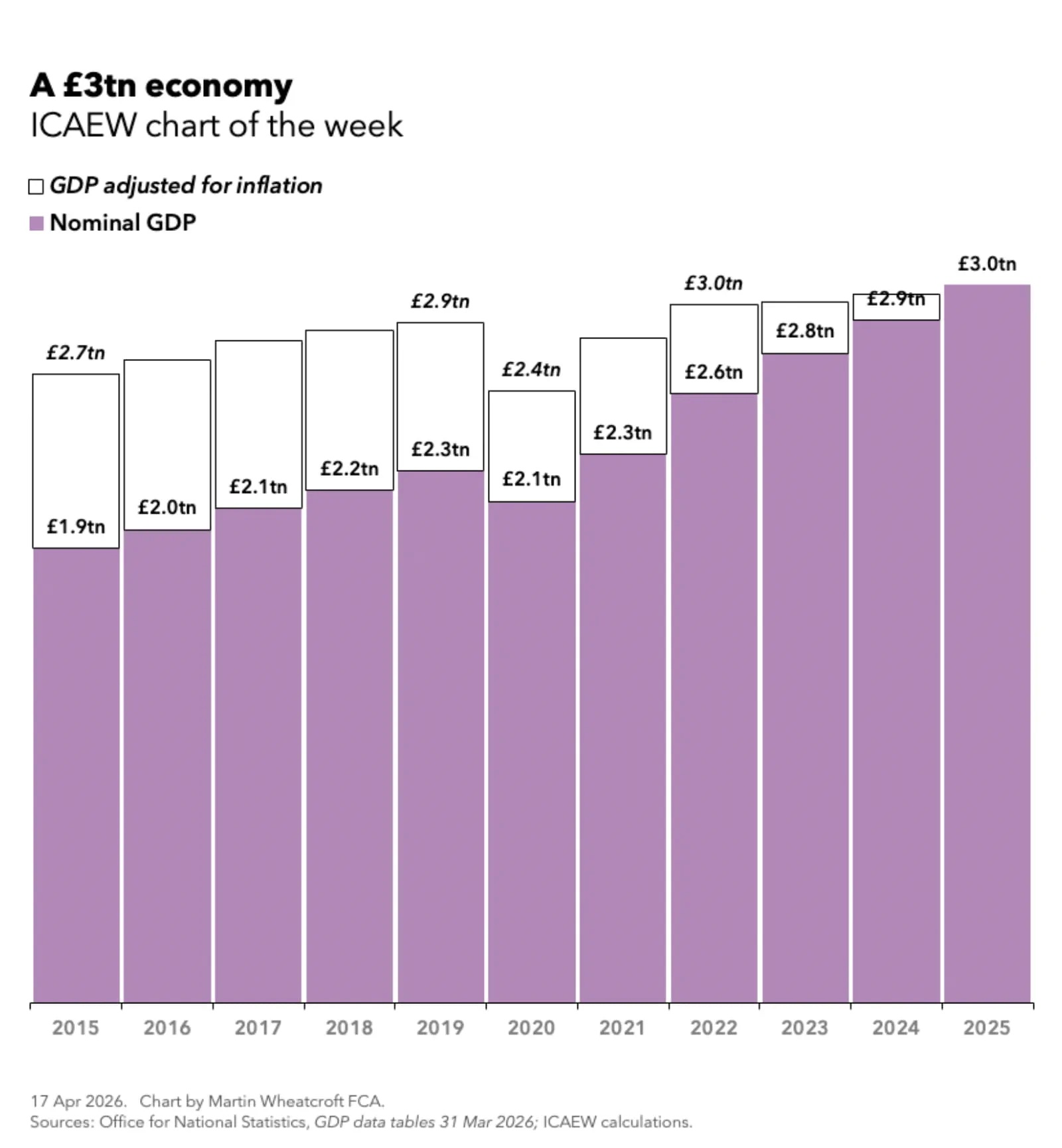
My chart this week for ICAEW is on how GDP for the UK reached £3.0tn for the first time in 2025. This is a 58% increase over the course of a decade, mostly driven by a combination of inflation and a rising population, resulting in a relatively small amount of per capita economic growth.
My chart of the week for ICAEW is on gross domestic product (GDP), the principal measure used by statisticians and economists to assess the size of the economy.
The chart shows how nominal GDP (GDP at market prices in current values) was £1.9tn in 2015, rising to £2.0tn in 2016, £2.1tn in 2017, £2.2tn in 2018 and then £2.3tn in 2019. Nominal GDP fell to £2.1tn in 2020 (the first year of the pandemic) and then rose to £2.3tn in 2021, £2.6tn in 2022, £2.8tn in 2023, £2.9tn in 2024 and then £3.0tn in 2025.
This is a cumulative increase of 58% over 10 years (or 4.7% a year on average), based on nominal GDP of £1,928bn in 2015 and £3,040bn in 2025.
The chart also shows the increase is much less dramatic using GDP adjusted for inflation (GDP at market values on a chained volume basis or ‘real GDP’). Recalculated into 2025 values, GDP adjusted for inflation was £2.7tn in 2015, £2.9tn in 2019, £2.4tn in 2020 and just under £3.0tn in 2022.
As ever with economic statistics these numbers are all subject to revision as the ONS obtains new or updated data and, every so often, revises its methodology.
Analysing the increase
The 58% increase in nominal GDP over the 10 years to 2025 can be analysed as a cumulative 38% increase from inflation (using the GDP deflator ‘all economy’ measure of inflation) and cumulative economic growth of 14%, with the latter being further analysed into a cumulative 7% increase in the size of the population, and a cumulative 7% increase in average economic activity per person.
This is equivalent to a 4.7% per year average annual increase in nominal GDP over the decade, comprising 3.3% per year in average annual inflation and 1.3% per year in economic growth. The latter comprises a 0.7% per year annual rise in population and a 0.7% increase in average per capita economic activity.
Economic growth has been particularly weak over the past three years in particular, with a cumulative increase of 17.8% in nominal GDP comprising cumulative inflation of 14.6% and a cumulative increase of 2.8% in GDP adjusted for inflation (from £2,958bn in 2022 adjusted to 2025 prices to £3,040bn in 2025).
As the population is estimated to have increased by 2.7% between 2022 and 2025, per capita economic activity over the same period has in effect been flat over the last three years.
Unfortunately, the outlook for the economy is far from rosy given recent international developments and there is now a risk that nominal GDP could fall back below £3.0tn in 2026, despite what is likely to be a higher rate of inflation than previously anticipated.
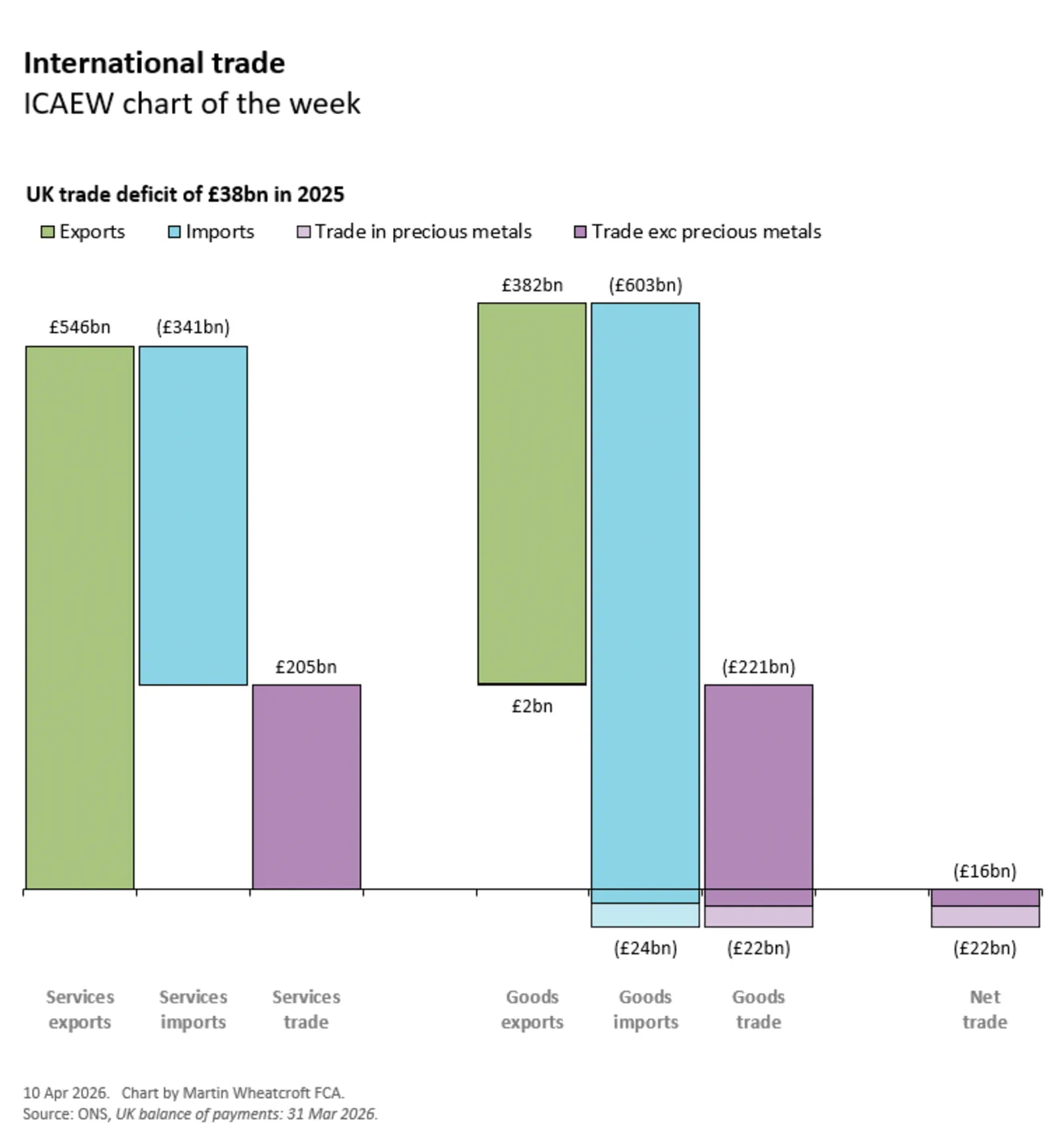
This week’s chart for ICAEW illustrates how a £205bn surplus on trade in services was offset by a £243bn deficit on trade in goods to result in a net trade deficit of £38bn in 2025 – or £16bn if trade in precious metals is excluded.
My chart this week for ICAEW is on the principal components of the UK’s £38bn trade deficit in the 2025 calendar year.
The chart starts with a £205bn surplus on trade in services (comprising a £546bn cash inflow from services exports less a £346bn cash outflow to pay for services imports) followed by a £221bn deficit on trade in goods excluding precious metals (comprising £382bn generated from goods exports less £603bn to pay for goods imports), and a £22bn deficit on trade in precious metals (comprising £2bn from exports less £24bn on imports).
Together these result in an overall trade deficit of £38bn, of which £16bn is a deficit on trade in goods and services excluding precious metals and £22bn relates to precious metals.
This is equivalent to a net trade deficit of 1.3% of GDP, comprising a surplus on trade in services of 6.7% of GDP (17.9% from exports – 11.2% on imports) less a deficit on trade in goods excluding precious metals of 7.3% of GDP (12.6% from exports – 19.9% on imports) and a deficit on trade in precious metals of 0.7% of GDP (0.1% from exports – 0.8% on imports).
The ONS publishes trade statistics that exclude precious metals because a large proportion of the value of this trade are sales and purchases of gold between UK and international holders that are really financial flows, often without any physical movement of the gold concerned. Not only can the volume and value of such transactions be quite volatile, but the trade deficit excluding precious metals of £16bn in 2025 is probably more representative of trade flows in that year than the overall trade deficit of £38bn.
The balance of payments
Not shown in the chart are the other components of the current account deficit of £74bn in 2025 and a capital account deficit of £5bn.
The former comprised a primary income or ‘earnings’ deficit of £19bn (being £417bn investment income coming to the UK and £2bn foreign compensation of UK-based employees less £435bn investment income going abroad and £3bn compensation of foreign employees) and a secondary income deficit or ‘net transfers’ of £17bn (£1bn UK government receipts £1bn and £30bn remittances and other inward transfers less £12bn UK government payments abroad and £36bn remittances and other outward transfers) in addition to the trade deficit of £38bn. The latter consisted of £2bn from international sales of non-produced non-financial assets less £7bn in purchases.
The chart also doesn’t show the £79bn surplus in 2025 on the other side of the balance of payments, being an £86bn surplus on financial transactions (£678bn in financial investments in the UK less £592bn in outbound financial investments) less £7bn in statistical errors and omissions.
The trade deficit over time
The trade deficits excluding precious metals of £17bn in 2024 and £16bn in 2025 were a little lower than the £24bn average over the last quarter of a century and were less than the net £19bn average over the previous four years that were distorted by the pandemic and the energy crisis (trade surpluses excluding precious metals of £14bn and £7bn in 2020 and 2021 followed by deficits of £50bn and £47bn in 2022 and 2023).
Whether you think the trade deficit is good or bad depends on your perspective, with some worried about the net cash outflows that result from payments for imports exceeding receipts from exports. Others points to the net positive inflows of goods and services that are coming into the UK in exchange for the money that we spend.
Either way, what we sell abroad and what we buy from overseas are important not only to UK businesses that trade internationally but also to all of us living in the UK.
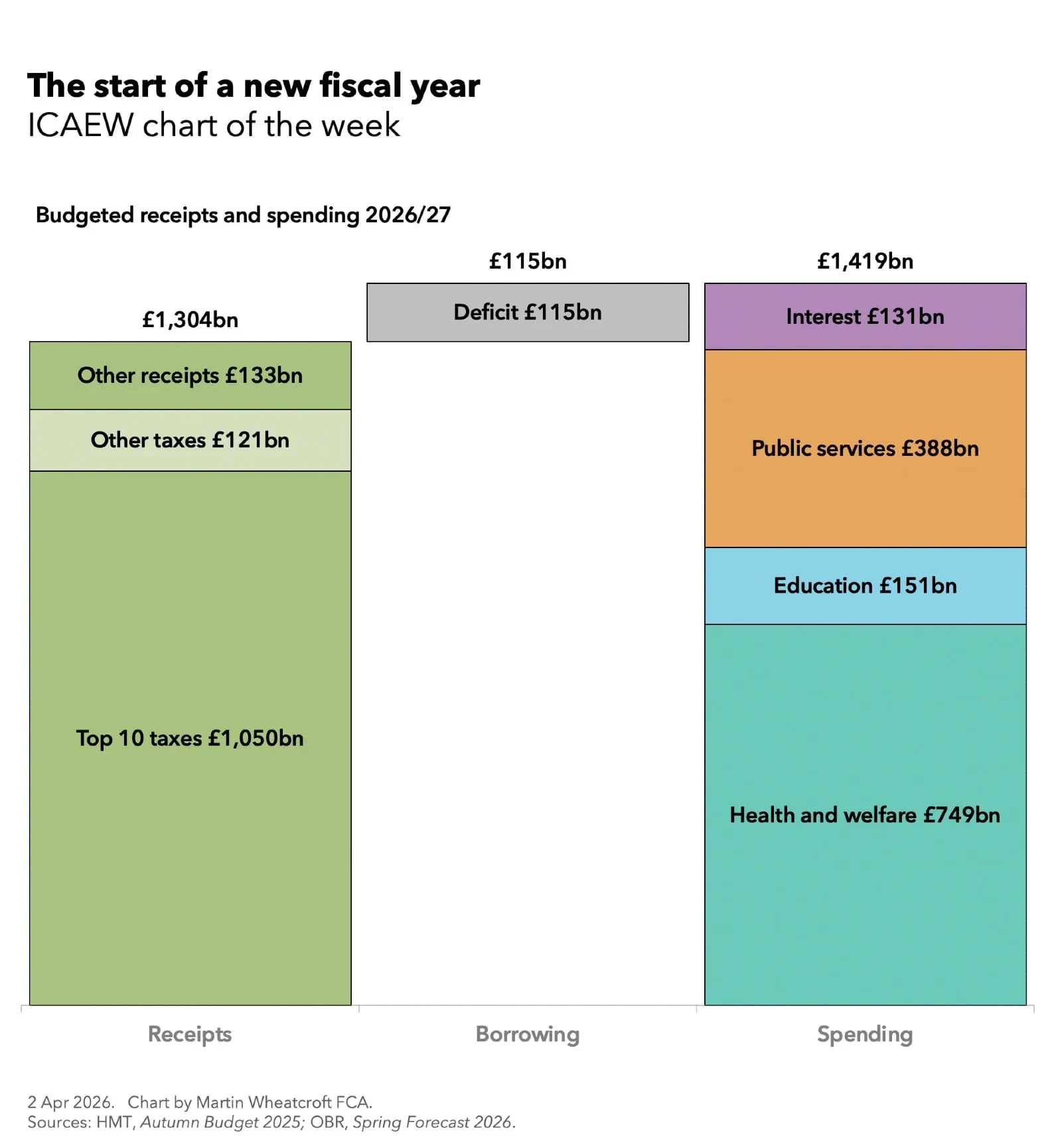
My first chart of the financial year starting 1 April 2026 for ICAEW looks at the government’s £1.4tn budget for 2026/27.
My chart fir ICAEW this week is on the public sector budget for the 2026/27 financial year which began on 1 April 2026, showing how there is expected to be a shortfall of £116bn between anticipated receipts of £1,304bn and planned spending of £1,419bn.
This is equivalent to a deficit of 3.6% of GDP, calculated as receipts of 41.2% of GDP less total managed expenditure of 44.8% of GDP.
The chart highlights how the top 10 taxes are expected to generate £1,050bn (81% of total receipts), with all other taxes contributing £121bn (9%) and other receipts generating £133bn (10%).
The top 10 taxes comprise: income tax which generates £360bn, VAT (£220bn), employer national insurance (£155bn), corporation tax (£102bn), employee and self-employed national insurance (£57bn), council tax (£54bn), business rates (£37bn), fuel duties (£24bn), capital gains tax (£21bn) and property transaction taxes (stamp duty in England) generating £20bn.
The remaining £121bn of tax receipts comprises £84bn from the next 10 largest taxes: environmental duties (£16bn), alcohol duties (£13bn), vehicle excise duty (£10bn), inheritance tax (£9bn), insurance premium tax (£9bn), tobacco duties (£7bn), air passenger duty (£5bn), stamp duty on shares (£5bn), customs duties (£5bn) and the apprenticeship levy (£5bn), and £37bn from all other taxes and duties.
Other receipts comprise £87bn from operating surpluses (including social housing rents and the profits of public corporations), £43bn in interest and dividends (on investments and cash balances), and £3bn other receipts.
On the spending side, the chart illustrates how the £749bn budgeted for health and welfare is more than half of the total (approximately 53%), while education spending is budgeted to be £151bn (11%), public services outside of health, social care and education amount to £388bn (27%) and interest is forecast to be £131bn (9%).
Health and welfare spending comprises £401bn on welfare (including the state pension), £294bn on health (principally the NHS), and social care provision of £54bn. Budgeted spending on public services outside of health, social care and education include defence and security of around £70bn, transport £69bn, public order and safety £62bn, industry, agriculture and employment £56bn, and housing and environment £51bn, together with £80bn across the hundreds of other public services provided by central and local government.
The planned borrowing to fund the deficit of £116bn, the difference between receipts and total managed expenditure, excludes £15bn in other borrowing to fund government lending activities and working capital movements, with public sector net debt scheduled to rise above £3tn during the coming financial year.
The problem for the Chancellor – and for all of us – is that the actual numbers for 2026/27 could be significantly worse from the budgeted amounts presented in our chart. Not only is she already under significant pressure to increase defence spending and alleviate student loans (amongst many other spending challenges), but the conflict with Iran will make the situation even more challenging for both the government and the nation.
On that cheery note, we would like to wish you all the best for the new (financial) year.
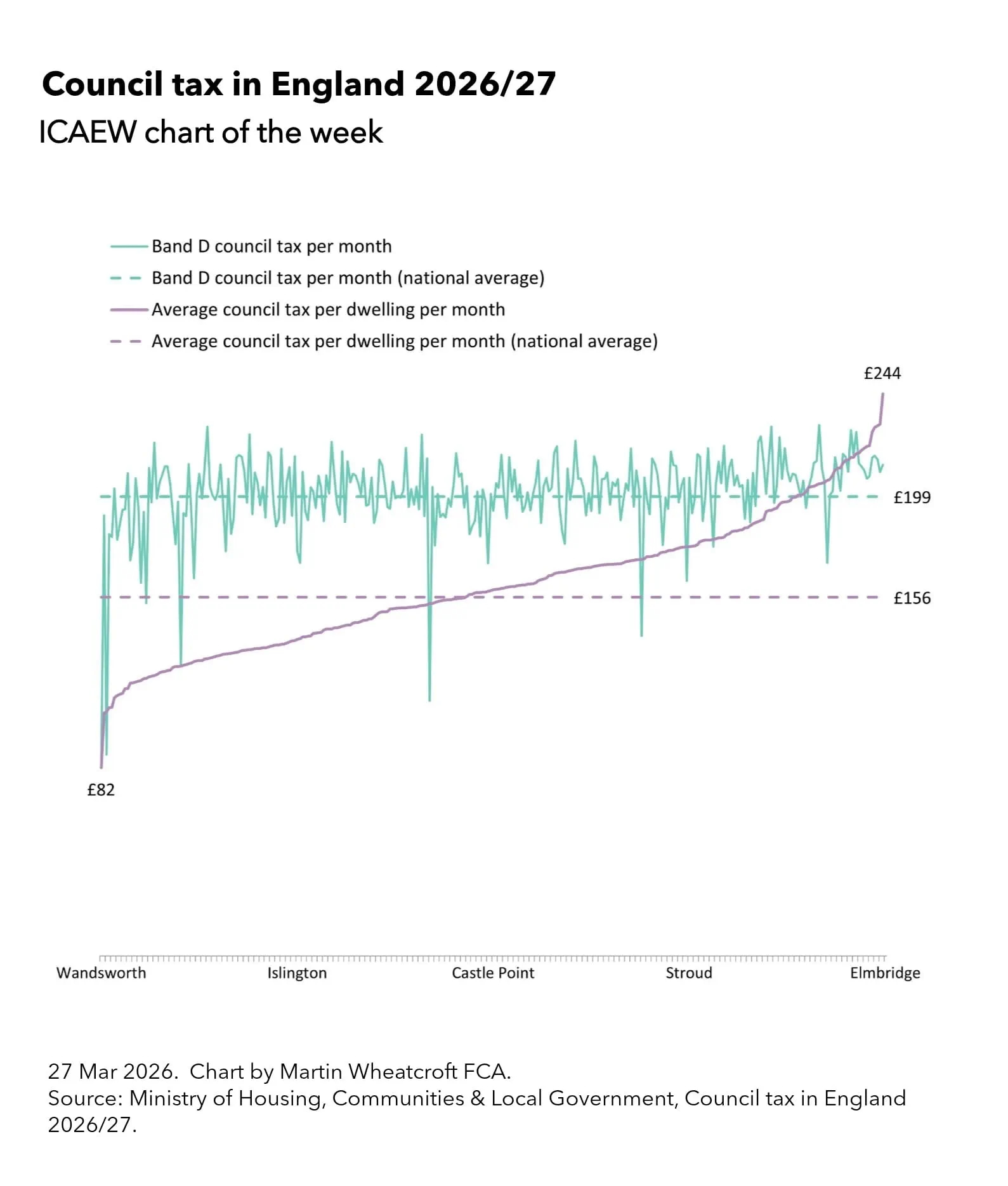
My chart for ICAEW this week celebrates the start of a new financial year by looking at the average level of council tax across England.
My chart for ICAEW this week illustrates the average council tax payable per dwelling by local billing authority in 2026/27, ranging from £82 per month in Wandsworth, £137 per month in Islington, £159 per month in Castle Point in Essex, £178 per month in Stroud, Gloucestershire, and £244 per month (£2,927 for the year) in Elmbridge in Surrey.
These compare with an average council tax per dwelling across England in 2026/27 of £156 per month, a 5.5% increase over 2025/26. This is based on a total amount of council tax of £46.8bn to be raised by 296 local billing authorities divided by approximately 25.1m residential dwellings in England.
Our chart also illustrates how the relationship between the average council tax per dwelling in each local authority area and the amount payable on a Band D property can vary significantly based on the proportions of residential properties in each band (based on 1991 property values). In some areas there are more Band E, F, G and H properties, which pay 22%, 44%, 67% and twice the amount payable on a Band D property respectively, while in others there are more Band A, B and C properties that pay 33%, 22% and 11% less respectively.
Overall, the national average per dwelling amount is 22% less than the headline rate of council tax on a Band D property of £199 per month, reflecting the approximately two-thirds of properties that are in Bands A to C nationally.
In the five highlighted local authorities, the average council tax per dwelling is 5% less, 22% less, 18% less, 14% less and £15% more respectively than their Band D rates of £86 per month in Wandsworth, £176 in Islington, £193 in Castle Point, £208 in Stroud, and £213 per month in Elmbridge.
The 296 billing authorities comprise 32 London boroughs and the City of London, 36 metropolitan boroughs, 62 unitary authorities and the Isle of Scilly, and 164 district councils. They raise council tax on behalf of themselves and (as appropriate) the Greater London Authority, 37 territorial police forces outside London, 29 fire and rescue authorities outside London, 12 regional combined authorities, and 21 county councils. They also raise precepts for just under 9,000 town and parish councils, mostly in rural areas.
Council tax in Wales
Not included in the chart are council tax bills for 2026/27 in Wales, where the average council tax per dwelling is £173 per month for its 22 principal councils, which raise £3.0bn in council tax from 1.4m dwellings for themselves, the four Welsh territorial police forces and around 730 community councils.
The average council tax per dwelling ranges from £137 per month in Caerphilly to £175 per month in Wrexham and £226 per month in Monmouthshire, respectively 21% less, 9% less and 12% more than the Band D rates in those councils of £174, £192 and £201 per month respectively. The national average of £173 per month is 9% less than the average Band D rate across Wales of £190 per month.
The variations reflect the differing proportions of residential properties in each band in each principal council area (based on 2003 property values), as well as the Welsh additional Band I that pays 17% more than a Band H property.
Changes ahead for councils
Back in England, the big development is the planned abolition over the next three years of the remaining county and district councils. The replacement of these two tiers with unitary authorities should establish a single principal tier of local government across the whole of England, while the gradual extension of regional combined authorities to cover more of the country should enable further devolution of responsibilities from Whitehall to the regions.
Although the rise in council bills will be unwelcome to many, the reality is that many if not most local authorities in both England and Wales are struggling financially, with the growing cost of local welfare provision (especially adult social care, child social care and homelessness) combined with limits on funding from central government continuing to squeeze budgets for local public services.
Whether the Chancellor’s proposed devolution of a share of income tax receipts to the English regions will make a significant difference to the financial health of local government remains to be seen.
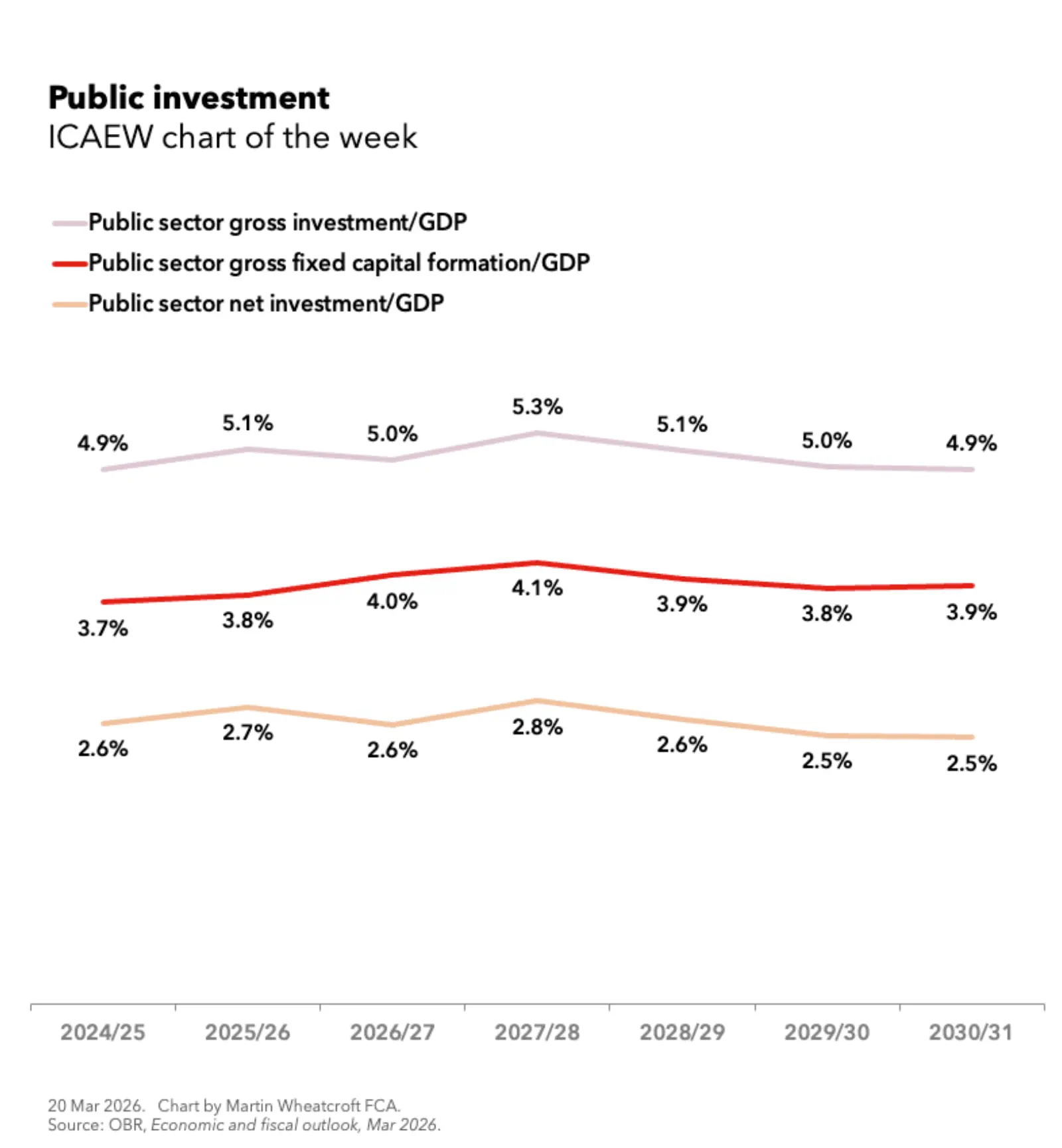
My chart for ICAEW this week looks at how public investment in assets is expected to increase over the next couple of years as the government seeks to stimulate the economy and “build build build”.
According to the Office for Budget Responsibility’s latest fiscal forecasts, public sector gross capital formation – the statistical equivalent of capital expenditure – is expected to increase as a share of the economy from 3.7% and 3.8% of GDP in the years ending 31 March 2025 and 2026 (2024/25 and 2025/26 respectively) to 4.0% and 4.1% in 2026/27 and 2027/28, before falling to 3.9%, 3.8% and 3.9% in 2028/29, 2029/30 and 2029/31.
My chart for ICAEW this week shows this trend, together with the headline percentages of public sector gross investment/GDP and public sector net investment/GDP. The former is expected to bounce around 5% of GDP – going from 4.9% in 2024/25 to 5.1%, 5.0%, 5.3%, 5.1%, 5.0% and then 4.9% in 2030/31. The latter is expected to go from 2.6% in 2024/25 to 2.7%, 2.6%, 2.8%, 2.6%, 2.5% and 2.5% in 2030/31.
Public sector gross investment is higher than gross capital formation because it also includes capital grants, research and development funding, and student loan impairments in addition to capital expenditure on infrastructure and other fixed assets.
Public sector net investment is equal to public sector gross investment less depreciation, to give an idea of much is new investment after taking account of the usage of existing assets.
The increase in public sector gross fixed capital formation – from £116bn in 2025/26 to £125bn in the coming financial year starting on 1 April 2026 (2026/27) and then to £134bn in the following financial year (2027/28) – is a substantial expansion in the level of public sector capital expenditure.
These increases, of 6% and 5% respectively over the next two years after adjusting for inflation, should be positive for an economy that needs every boost that it can get. If it can help unlock incremental private sector investment too, the economic benefit could be even greater.
The challenge is that while additional investment is welcome, this is not a transformative change, especially as the increase as a share of the economy is not expected to be sustained beyond the first couple of years of the forecast period.
The expectation of many commentators was that the Chancellor was hoping for improvements in the economy to allow her to pencil in further increases in 2028/29 and beyond. Recent events suggest this hope may be less likely than it once was.
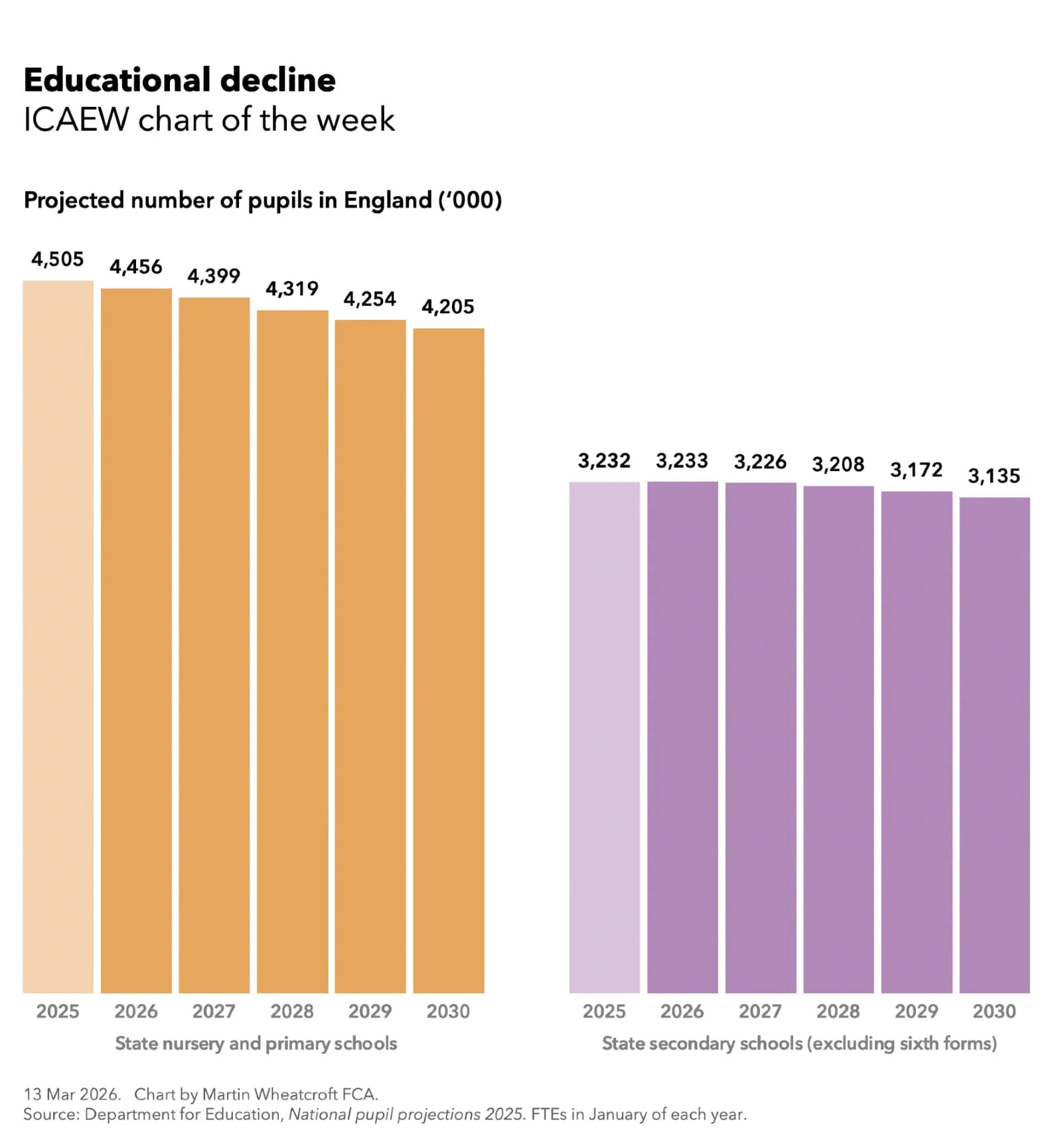
My chart for ICAEW this week looks at how school rolls in England are projected to decline by 7% in state nurseries and primaries and 3% in state secondaries over the next five years, and what that means for school closures and mergers across the country.
According to Department for Education statistics, there were 8,384,000 school pupils under the age of 16 in England in January 2025 (ages recorded as of 31 August 2024). Of these, 4,505,000 were in maintained nursery and state primary schools, 3,232,000 were in state secondary schools, 146,000 were in state special schools, 482,000 were in independent schools and 16,000 were in alternative provision.
My chart for ICAEW this week shows how the largest two categories of schools are projected to change over the next five years, starting with a projected 7% fall in pupil numbers in state nursery and primary schools from 4,505,000 in the last academic year to 4,205,000 in 2030. This follows a decline of 3% since 2019 when state nursery and primary numbers peaked at 4,652,000.
Meanwhile the number of state secondary school pupils under the age of 16 at the start of the academic year is expected to decline from 3,322,000 in January 2025 to 3,135,000 in January 2030, a fall of 3% from the peak.
Driven by a falling birthrate, the 7% projected fall in state nursery and primary school pupils is likely to be a political hot potato for local authorities and government in the face of what is likely to be a large number of ‘save our local school’ campaigns. London has already seen a significant number of primary school closures over the past five years, but the further drop projected is likely to see most parts of the country affected to a greater or lesser extent.
The 3% decline from the peak in secondary school pupil numbers will also present challenges, especially as the fall in numbers is unlikely to be spread evenly across the country. Some will see smaller falls or even rises in their school rolls, while others will see a much greater drop in their intakes. Reducing the number of classes in each year is a likely response for some schools, but entire school closures and mergers are almost inevitable.
The core of the projections is the provision of school places for children who are already in the education system or have already been born, but uncertainties about the rapidly falling birth rate meant that the Department for Education limited their projections to five years instead of their traditional ten-year outlook. With these projections, the main uncertainty is in the level of migration, with government actions to restrict legal immigration likely to see the next projections revised down even further when they are released this summer.
In theory, falling school rolls should reduce pressures on the education budget while at the same time potentially increasing per pupil funding. In practice, pressures on the public finances are so large that the government is likely to be looking for every saving they can find.
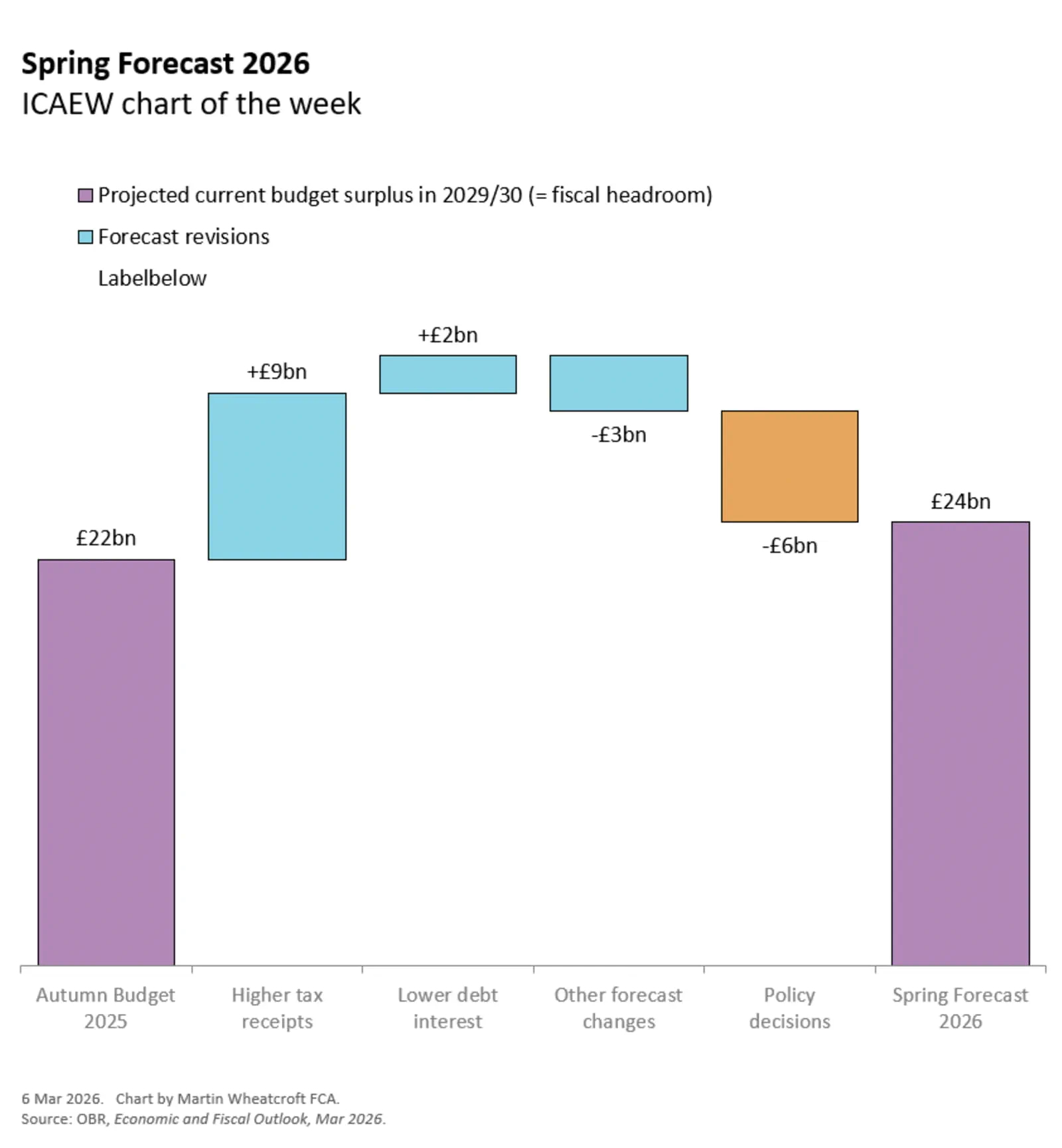
My chart for ICAEW this week looks at how the Chancellor’s fiscal headroom increased by £2bn to £24bn in the latest fiscal forecast from the Office for Budget Responsibility.
The Chancellor presented the latest fiscal forecast prepared by the Office for Budget Responsibility (OBR) to Parliament on Tuesday 3 March 2026 together with an extensive defence of the government’s economic record since taking office almost two years ago.
The good news for the Chancellor was that she was able to report that the fiscal headroom against her primary fiscal rule has increased from £22bn in the Autumn Budget 2025 to £24bn in the Spring Forecast.
My chart for ICAEW this week illustrates the components of this change, with forecast revisions by the OBR adding £8bn to the projected budget surplus in 2029/30 – the fourth year of the forecast period – before deducting £6bn for the net cost of policy announcements made by the government since November last year.
The forecast revisions start with £9bn in higher tax receipts, of which £6bn relate to higher equity prices boosting projected capital gains tax and carried interest income tax receipts and £3bn to other tax receipts, primarily from stronger economic growth predicted by the OBR between 2027 and 2030.
A further £2bn of uplift comes from lower debt interest charges in 2029/30 as a consequence of a reduction in the OBR’s predictions for inflation and interest rates.
This was then offset by £3bn from other changes to the forecast for current expenditure, including £1bn in higher welfare spending and £2bn for other reasons.
The £6bn (£5.7bn before rounding) net cost of policy decisions comprised £4.4bn in extra SEND funding as announced by the government eight days before the Spring Forecast and £0.5bn in other spending increases announced since last November – a total of £4.9bn in additional spending in 2029/30. This was partially offset by additional council tax increases of £0.5bn before taking account of tax cuts in 2029/30 of £0.7bn for US-parented groups, £0.1bn relating to inheritance tax on farmers, £0.2bn in other tax cuts and a £0.3bn indirect impact on receipts from policy decisions.
Not shown in the chart is net investment, where the OBR reduced the projection for 2029/30 by £3bn from £90bn to £87bn. This means the projected fiscal deficit for 2029/30 has reduced from £68bn (a previously projected current budget surplus of £22bn less £90bn net investment) to £63bn (a current budget surplus of £24bn less £87bn).
Reacting to the Spring Forecast, ICAEW’s Chief Executive, Alan Vallance, said: “While businesses will be relieved that they will not have to respond to any major policy announcements from the Chancellor, their attention will be turned to the situation in the Middle East. In an increasingly volatile world, having just one fiscal event a year is the right move to dampen speculation and increase certainty.
“Our members tell us that they want stability, but since these forecasts were finalised, the world has again changed. People and businesses will be concerned about the impacts of more geopolitical uncertainty, and it is inevitable that costs, particularly energy costs, will rise.
“This unfolding crisis underscores the need to foster a more stable and supportive environment for business, including developing a long-term fiscal strategy that puts the public finances on a more sustainable path and an urgently needed commitment to comprehensive tax reform.”